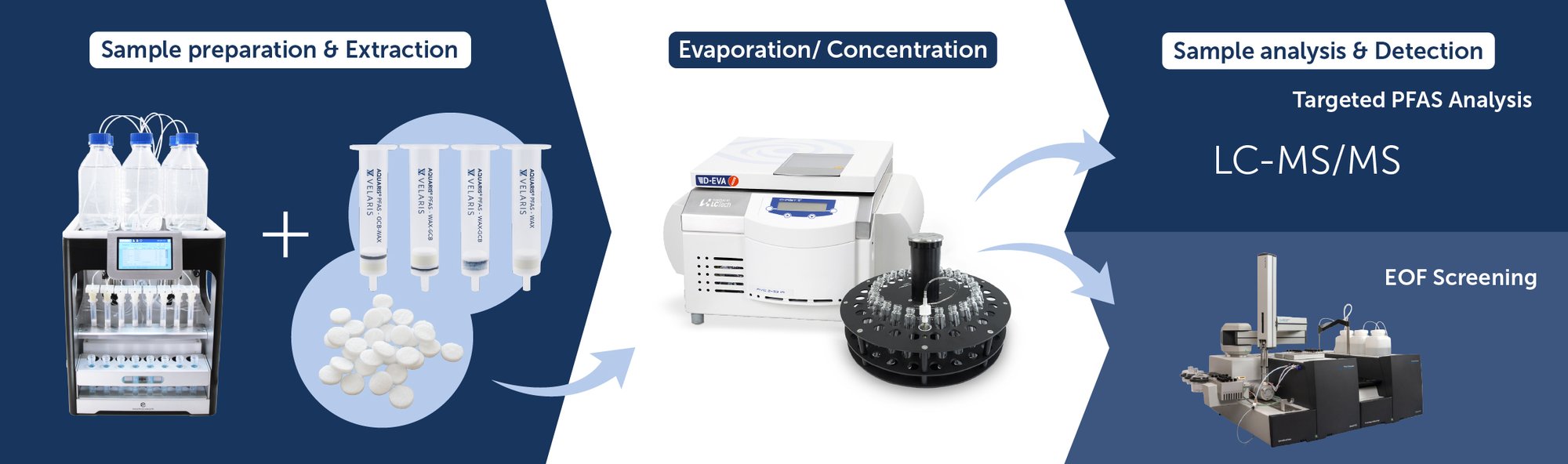
SPE for targeted PFAS + AOF/EOF for total fluorine screening
PFAS Water Compliance Workflows Across Simple and Complex Matrices
Meet evolving PFAS regulations with automated, high-throughput workflows, from sample preparation to analysis and detection, using SPE, EOF, and AOF workflows.
Common PFAS Challenges
- Increasing sample volumes
- Stricter detection limits
- Complex wastewater and sludge matrices
- Manual sample preparation bottlenecks
- Evolving PFAS regulations
How Velaris Helps
- High-throughput via automation
- Reliable trace-level analysis
- Solution for complex matrix + experts for advice
- Automation cut manual workload significantly
- Up-to-date compliance-ready solutions
PFAS Regulations are Tightening Worldwide
- EU Drinking Water Directive: 0.1 ug/L for sum 20 PFAS (2026)
- Germany and Nordics: Stricter national limits
- Growing requirement for wastewater and sludge
- EU Urban Waste Water Directive 2024/3019 is expanding
- US EPA National primary drinking water regulation (2024) - ppt level limits
- Canada guidline: 30 ng/L (sum of 25 PFAS)

Expert Insight: What Tightening PFAS Regulations mean for your Lab
Roel Kwanten, Water Quality Specialist, Rijkswaterstaat (NL)
PFAS monitoring is becoming more demanding, with stricter limits, broader compound lists, and increasing testing pressure. We spoke with Roel Kwanten from Rijkswaterstaat about regulatory trends and the growing impact on laboratories.
The Right Analytical Workflow for Every PFAS Water Regulation
Laboratories need a robust analytical workflow to quantify known PFAS and screen for unknown PFAS across a wide range of aqueous matrices. Velaris automated workflows are built to handle even the most complex samples while maintaining high throughput, enabling laboratories to achieve accurate, reliable, and efficient PFAS analysis.
Drinking Water
Example of Regulations
EU Water Framework Directive (2020/2184).Sum of 20 PFAS: 0.1 μg/L
US EPA NPDWR (2024) 4-10 ppt for individual PFAS
Other countries have national limits
Relevant Analytical Methods
DIN 38407-42; EN 17892; ISO 21675; EPA533; EPA537; EPA 1621; etc.
Workflow to use
Surface Water & Groundwater
Example of Regulations
EU Water Framework Directive (EC) No2000/60
Various national environmental quality standards
Relevant Analytical Methods
DIN 38407-42; EN 17892; ISO 21675; EPA 1633;etc.
Workflow to use
SPE for targeted PFAS + AOF/EOF for broader contamination screening
Wastewater & Sludge
Example of Regulations
EU Urban Wastewater Directive (EU) 2024/3019
National Wastewater Discharge Limits
Relevant Analytical Methods
EPA 1633; etc
Workflow to use
Broad contamination monitoring, complex matrix PFAS
AOF by combustion
EOF where applicable SPE for targeted PFAS
Multiple Workflows, Complete Coverage, High Throughput Automation
Combine SPE, EOF, and AOF workflows to efficiently meet PFAS regulations, increase throughput, and ensure trace-level analysis.
SPE & EOF Workflow
Common automated sample preparation solutions, including extraction/cleanup and evaporation steps, can be used for both target PFAS analysis and EOF screening.

SPE-03
The SPE-03 automated SPE system processes up to 8 samples in parallel, with flexible bottle mounting for sample volumes from 0.5 to 4000 mL, built for high-throughput extraction across complex matrices.
High Capacity Inline Filter (F-HC-30)
A high-capacity inline filter designed to remove both fine and large particulates. Suitable for processing up to 1 L of drinking water, surface water, or wastewater.
Aquaris PFAS Cartridges
PFAS-specific SPE cartridges optimised for seamless integration with SPE03 automation. Designed to provide robust PFAS enrichment, cleanup, and recovery while supporting compliance with major regulatory methods and standards
Anti-Clogging Cartridge Frits (CF-06 or CF-03)
Multi-layer frits are installed on top of the SPE cartridge, before extraction, to reduce the likelihood of cartridge clogging when processing challenging matrices.
D-EVA
The vacuum concentrator D-EVA allows unattended, parallel and rapid concentration of up to 53 PFAS samples with automatic stop at a defined end-volume between (e.g. 500-900 ul). The quantitative transfer into a GC vial is possible without time-consuming rinsing of the sample vessel.
Xprep C-IC
Combustion unit connected to Ion Chromatography. Pyrohydrolitic combustion of the extracted liquid containing PFAS. The formed HF is absorbed with UPW in a fraction vial. These negatively charged ions, will be injected and separated in the IC column.
AOF Workflow
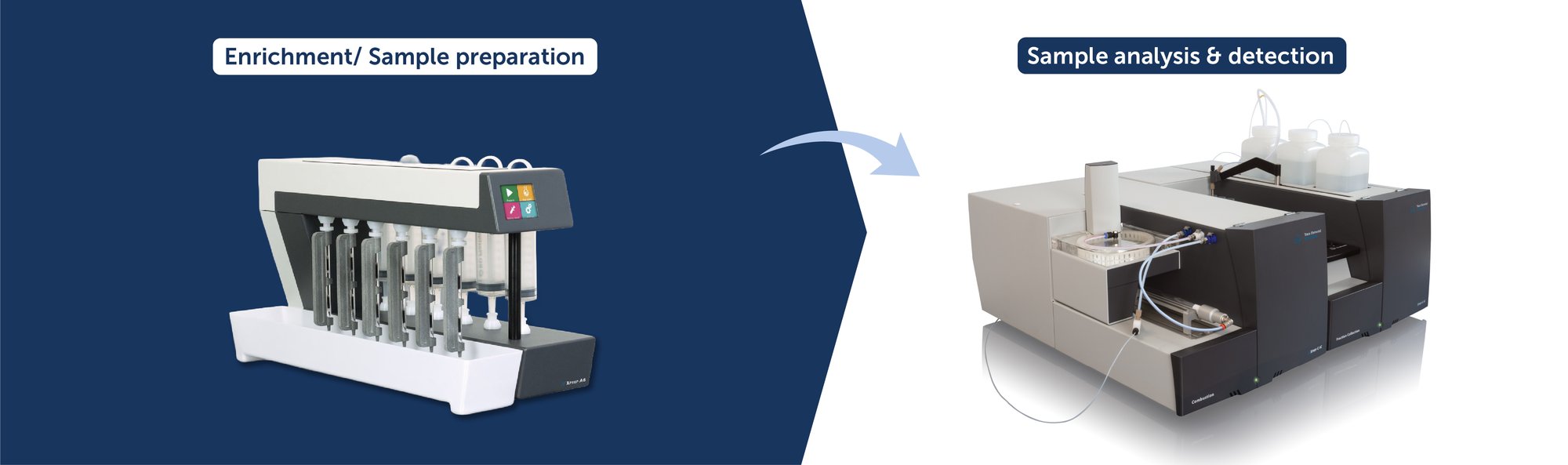
AOF (Adsorbable Organic Fluorine) analysis for PFAS screening.

Xprep-A6
Autosampler designed for accurate, rapid and easy sample preparation of samples that require sample pretreatment for AOX/TOX and AOF analyses according to the column method (EPA 1621).
The water samples automatically pass through the columns, where organically bound halogens were adsorbed onto microcolumns filled with activated carbon.
The Xprep-A6 serves as a stand-alone system for preparing samples for AOF analyses, which can be carried out by the Xprep C-IC.
Xprep C-IC
These microcolumns were then placed into the Tuscan autosampler, which introduced them into the Xprep C-IC sample boat.
The activated carbon is combusted in an oxygen-rich environment at high temperature. After combustion, the output gas stream containing the analytes is transferred to the Fraction Collection Unit and trapped in the absorber solution.
No additional autosampler is required, as the fraction collection unit of the Xprep C-IC also functions as an autosampler for the IC. It allows the collection and storage of up to 65 combusted samples.
Join our PFAS Webinars
Automated SPE Sample Preparation for PFAS & Ultra-Short-Chain PFAS in Aqueous Matrices
From high-throughput extraction and anti-clogging strategies to up-concentration and LC-MS/MS analysis
July 14th at 2:00 PM (CET)
Fast Screening of PFAS in Aqueous Sample Matrices using Combustion Ion Chromatography
Automated screening technique for Adsorbable Organic Fluorine (AOF) and Extractable Organic Fluorine (EOF) with the Xprep C-IC
August 25th at 2:00 PM (CET)
Automate Your Lab to Meet Growing Demands